Hideo's final visit and sukiyaki farewell with his parents
Strangers (Taichi Yamada Edition)Hideo Harada’s final visit and sukiyaki farewell with his parents marks the passage from repeatedly entering an imagined family reunion in Asakusa to accepting that the visits must end. The farewell is not only a last shared meal: as his parents vanish, the objects left on the table become material traces of a relationship he can carry back into ordinary life.
Background and Decision
Before deciding to go, Hideo had tried to make sense of his encounters in Asakusa. He recognizes that the experience may have existed entirely in his mind, yet considers the possibility that a comforting hallucination need not be rejected simply because it is unreal. His mother had identified herself only after speaking to his back; they had not yet had the chance to speak as parent and child. Their imagined ages sharpen the impossibility of the reunion: his parents appear in their thirties, while their son is forty-eight. Hideo nevertheless wants to embrace the world in which that relationship can exist.
The attachment carries an unsettling responsibility. Hideo imagines that the time his parents spend between his visits may be a void, as though they remain frozen until he returns and breathes life into them. This belief helps explain the emotional weight of ending the visits: leaving Asakusa means not simply losing a comfort, but relinquishing the role he has imagined himself playing in his parents’ renewed existence.
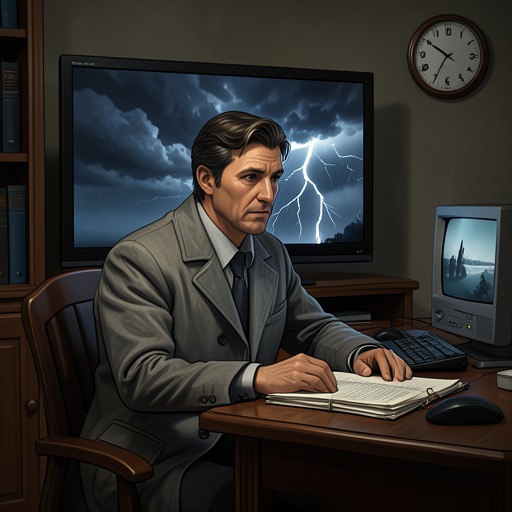
The choice also follows a moment of isolation in Tokyo. During a violent thunderstorm, Hideo watches rain and lightning from a high-rise hotel bar and longs for a world that is bright, transparent, and sharply defined. He dreads going home to his empty apartment, while recognizing that the danger he fears lies in himself rather than in the apartment. The storm does not resolve his uncertainty; instead, it makes the pull between ordinary solitude and the ambiguous world of Asakusa more pronounced.
When a driver’s brakes screech in the street but no crash follows, Hideo tells Kei that he needs to go to Asakusa that night. He explains that he must make one final visit precisely because he values what has begun between them. His decision therefore holds two attachments in tension: the parents he has found again in Asakusa and a relationship with Kei that he does not want to lose. He also admits that he cannot take the matter to the police, underscoring how little the experience can be addressed through ordinary means.
The Last Visit
Hideo tells his parents that he will not be able to visit again after that day. His mother is concerned and his father asks what he means; their responses make the announcement a shared family moment rather than a private resolution. His father initially accepts that nothing can be done, and his mother says that even their brief time together has made them happy. Then his father abruptly proposes going out for sukiyaki, choosing a meal together instead of allowing the farewell to end at the apartment.
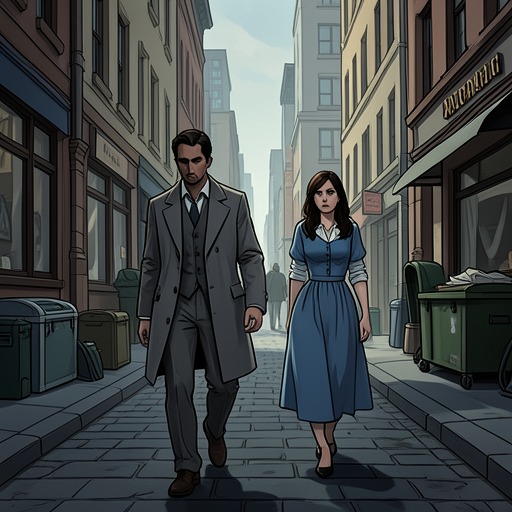
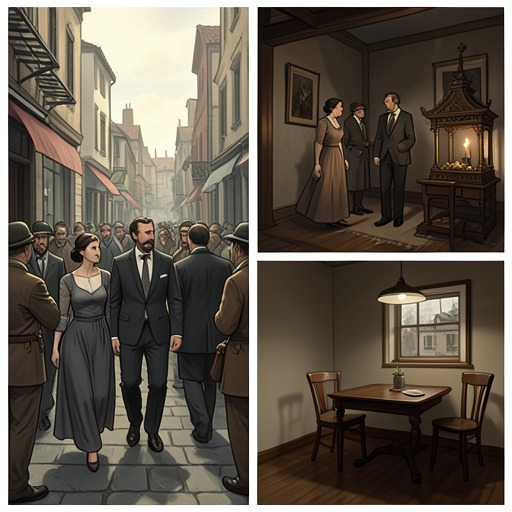
His mother agrees through tears, recognizing that they are saying goodbye. In the deepening dusk, the three walk toward Kaminarimon Gate. After crossing International Boulevard, they pass a shop grilling skewered lamprey livers; Hideo’s father suggests that each of them have one. The small detour and the silence that settles over them give the departure the shape of an ordinary family outing, even as all three understand that it is not ordinary.
Hideo suggests going up to the temple to pray to the Goddess of Mercy and browse the shops along the way, eating small cakes as they go. His parents wish they could, but explain that they are not free to do whatever they please. His mother’s tears and slumped shoulders contrast with her earlier animation at cards. Hideo nearly withdraws his promise to stay away, but the scene makes clear that his parents’ limits cannot be overcome by wanting to prolong the visit.
The Meal and Disappearance
At the restaurant, Hideo challenges the image his parents have formed of him. He says that he failed as a husband and was not much of a father, and doubts that he deserves the warmth they have shown him. He also questions whether he would have treated them well had they lived through the intervening years. His self-accusation interrupts the meal at the moment his mother begins to become transparent: Hideo can see through her shoulders. His father’s shoulders and torso fade as well.
The disappearance makes the meaning of his mother’s earlier words unmistakable. Hideo understands that this is how his parents are leaving, and sits stunned, unable to stop them. As his father’s shoulders disappear and his mother’s face dims, he thanks them repeatedly, keeping his voice low so that the restaurant’s waitress and other customers will not notice. His mother says goodbye; his father answers, and then is no longer visible. Hideo is too devastated to cry.
His parents vanish without a trace of themselves, but the meal remains in fragments: their chopsticks, sukiyaki bowls, half-empty beer glasses, a bag of figurine cakes, the soiled table, and two wrinkled cushions. Steam still rises from the simmering pan. The waitress, who had seen them enjoying the meal, asks what happened. Hideo cannot hide his distress; after she turns off the gas and goes to prepare the bill, he gathers the two pairs of chopsticks and carefully wraps them in a handkerchief. Even paying requires an enormous effort.
Keepsakes and Continuing Connection
The chopsticks turn the farewell into something Hideo can preserve. He does not leave with his parents, nor can he keep the reunion going; instead, he carries away an object they used together at their last meal. The surrounding leftovers underscore the difference between the parents’ disappearance and its physical aftermath: the people are gone, while the traces of their shared evening remain on the table and in Hideo’s hands.
Two years later, Hideo visits the family grave in Aichi, where his parents’ ashes are buried, with Mamiya. He brings incense, a burner, and chrysanthemums wrapped in newspaper, and shares the incense between two holders before praying alongside Mamiya. At the grave, he thinks of bringing his parents’ chopsticks from their last meal on his next visit, burning them and praying again. The farewell thus does not erase his bond with his parents. It changes its form: the repeated return to their imagined home gives way to remembrance anchored in a keepsake, a grave, and a prayer.
Narrative Significance
The event joins a departure from Asakusa to a return to the living world. The setting carries the sense of a boundary between ordinary time and Hideo’s intimate, uncertain encounters with his parents. In the August period when many Tokyo shops are closed for the Bon festival and the city is unusually quiet, his farewell takes place against a calendar associated with the returning spirits of the dead. The visit is shaped by threshold gestures—leaving the apartment, walking through the dusk, sharing a meal, and finally carrying the chopsticks away—without making the boundary between the living and the dead fully knowable.
The emotional turn comes when Hideo’s attempt to explain his failures coincides with his parents becoming visible through and then disappearing. Their departure does not confirm that the earlier reunion was objectively real; instead, it gives its consequences a tangible form. The chopsticks and other remains let the scene hold both loss and continuity: Hideo cannot keep his parents present in Asakusa, but he can remember the meal and carry its trace into later acts of mourning.